
"Teacher? How do you spell _______?"
We've all heard this question countless times, especially in the beginning of the year. So, the challenge for teachers becomes: How do we help students develop confidence in themselves as writers, so that they rely less on us?
The answer?
Tools and routines!
Give students the tools and routines they need, and they will assume the responsibility for their writing!

Here are some tools and strategies that I share with my young writers:
1) First of all, clearly communicate that you value content and voice, over spelling words correctly. If students feel like spelling the words correctly is the most important aspect of writing, they will become bogged down in the tediousness of making sure every. single. word. is. spelled. just. right. That leaves very little brainpower for creativity and craftsmanship. (P.S. - I'm not saying that it is not OK to hold students accountable for some agreed upon high frequency, or word wall/sight words. Just keep it reasonable.)
2) Motivation! The two biggest motivators for young writers are a) choice and b) an authentic audience and purpose. I know what you're thinking. "But, I've got district tests to administer! I can't just let my students write about Minecraft all year!" Here's the thing. Writers are passionate, curious, and maybe just a bit obsessed, by nature. If you embrace the idea of allowing your students to choose their topics, you will be amazed at how engaged they will be, during writing workshop. So, yes! You actually you can have a student write about Minecraft all year long. In fact, I have one this year. He has written a story about "Creepers", an elaborate "how-to" guide to Minecraft, and has shared several opinions and book recommendations, all about Minecraft. He has also written about tigers, bats, his family, and created a whole new chapter book titled "The Crazy Stick Family." What I am saying is, try to be flexible.
The other big factor here is audience and purpose. Ask yourself, "Who reads my students' writing?" If the answer is "only you," that is part of the problem. Students need opportunities to share their writing on a daily basis with an audience, and preferably, an audience that extends outside of the four walls of your classroom. So, have students read their pieces to their book buddies, send students up to the principal to share their writing, have a Family Writing Night. Get creative, so that students feel that their writing has true purpose.
3) One of the first mini-lessons I do in the beginning of the year is modeling stretching out sounds. The whole point of writing is to communicate. So, teaching students to do their best to sound out words and write as many sounds as they can, is an invaluable lesson for young writers. (P.S. This lesson directly connects to the Stretchy Snake reading strategy. Make that connection between reading and writing whenever possible for students!)

4) Sound-Spelling Cards: Ok, I am thinking back to a time that brings back hard feelings. Our district participated in the Reading First Initiative. We underwent countless hours of mandatory trainings, and were expected to maintain 100% fidelity to our basal. Blech! Dark days, friends. Dark days.
One good thing (there were a few) that came with that, were our Sound-Spelling Cards, which I still use to this day. These are an excellent visual in the classroom to communicate to students the idea of being FLEXIBLE when it comes to spelling words. This tool requires multiple mini-lessons throughout the year, in order for kids to use them regularly, and effectively. I have the large versions posted along the top edge of our front wall.


There are some free ones (not the same ones I have though) on TPT, if you search "Sound Spelling Cards".
5) Using Resources: Each of my students has a writing folder. Inside, each students will find:

**Writer's Dictionary: Once again, this is the kind of tool that requires multiple mini-lessons throughout the year. Model using it often for your students in your own writing. TIP: If my students can't find a word in their dictionary, they think of the first sound/letter in that word, open to that page, and raise their dictionary in the air. As I wander through the room and conference, I will write a word (if it is not decodable), as needed. Students do not come to me, or follow me around, because that would make me crazy.

**Parts of Speech Flipbook: I made this interactive flip book so that my students would have something to refer back to all year long when we talked about good writing. We use it as a place to collect words we love! Teaching students to read like writers is a very powerful practice. When students are reading and come across a word that they find particularly interesting, they jot it into their flip books. The fact that students have to categorize their favorite words by parts of speech, is a great way to reinforce grammar skills.
I have this available as a FREEBIE in my store (The freebie includes nouns, verbs, pronouns, and adjectives), or for purchase in the larger sized version you see above. It is faster to assemble and includes nouns, verbs, linking verbs, pronouns, adjectives, adverbs, and more. Click on the image below to learn more about either version.

**Writing Tools Flipbook: I created this flip book as a reference tool to help my students with specific areas of writing. This book was created with 2nd grade in mind, but teachers of 1st-3rd have found it useful, too.

Inside, my students can reference...
*quick refreshers of previous mini-lessons
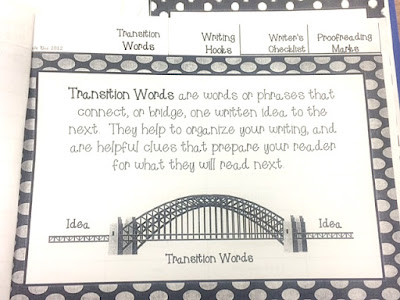
*lists of transition words

*ideas for writing hooks

**writer's checklists for narrative, opinion, and informative writing
** and a proofreading marks page
6) Writing Partnerships and Classroom Experts: Writing partnerships are a wonderful way to share expertise in the classroom. The more your students see each other as helpful resources, the less apt they will be to only turn to you. Writing partners ask each other for help, share their writing, and give feedback and encouragement to each other. Pair students together that compliment each other. Think about each student's strengths and weaknesses, and use that to make your partnerships. A student who is a poor speller might pair well with a child who rocks at it. A young writer who struggles with ideas might benefit by working with a student who sees story seeds everywhere! From my learning, partnerships work best when they are stable, so try to maintain the same partnership for each unit, or at least a few months.
I love this idea of "Classroom Experts" from Writing Workshop: The Essential Guide, by Ralph Fletcher. (affiliate link below)


It is a new one for me, but perfectly matches my philosophy, as described above. Make your students the experts! In his book, he suggests making anchor charts that list different areas of writing, for example: spelling, complete sentences, word choice, story ideas, writing hooks, paragraphs, dialogue, editing, or revising, and then writing students' names underneath those categories, if they have proven to be especially good in one of the aforementioned areas. Students who are struggling with one of these areas, can refer to the chart, and then seek out a conference with the expert. He even suggests that students make appointments with the expert. I just love it! Genius!
7) Checklists and Anchor Papers: I am a big believer that students will rise up to whatever level of expectations we set. So, whenever we start a new type of writing, I like to provide an exemplar for my students to study. Once again, this goes back to having students read like writers. They look at these anchor papers to notice the elements of that type of writing, the structure, and other evidence of author's use of craft (word choice, sentence length, etc...)
We use our classroom observations to construct the beginning of a checklist. I add anything else from my district's rubrics, that I know the students will need to be successful. I usually add it after a mini-lesson, so that my students don't become too overwhelmed. Here is a shot of our Informative Writing checklist. We added "text features" to this chart later on.

So, where do I get these anchor papers, you ask? Well, I have some from Lucy Calkins' Unit of Study kit, but I also save any really good writing from previous years. You could also coordinate with others at your grade level. Just make a copy, and hold onto it. While I prefer to use student writing, you can always model with your own writing, as well, as part of your mini-lessons. Kids need to see us write regularly!
8) Anchor Charts: Leave tracks of all of your mini-lessons by making anchor charts, and leaving them up around the room, at least for the duration of your unit. Some charts will prove to be timeless, however. (Reality Check: I don't know about you. But, I may just be an "anchor chart-aholic." Real estate in which to hang an anchor chart is at a premium in my classroom. So, one tip I have, is to take pictures of any anchor charts that you intend to take down, and make a binder/poly folder with all of the pictures. It can be a very helpful reference tool, and comes in handy during conferences and small group work. I do the same with all my reading anchor charts, too. Makes it so easy when it is time to make the chart again, the following year.)
Looking for more writing ideas? Follow me on Pinterest!
Alright, that is it, my friends. I hope you found some interesting nuggets to use in your classroom. I would love to hear what successes you have had in your classroom with regards to developing independent writers. Share, by leaving a comment below.
Nicole


